
Successive elections since 2019 have proved that the Modi charisma and Shah's strategy does not work in Tamil Nadu. Now, they have to see next year if the DMK is capable of losing, whether to an existing NDA alliance or an expanded version, if one becomes necessary and possible!, explains N Sathiya Moorthy.

This might help explain why our global outreach has received such a tepid response. We have chosen to be transactional with the world, as our UN votes reveal, points out Aakar Patel.

The outfit suggested that the government amend the Information Technology Act to classify all such content as pornography, which people should only be able to access by punching in their Aadhaar details or their fingerprints. Archis Mohan reports

Successive elections have demonstrated that the BJP campaign switches towards polarisation when it is faced with palpable discontent among the electorate, notes Utkarsh Mishra.
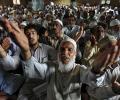
'The Ulema have come out as villains against Indian secularism, impeding the secular united resistance against violent Hindutva that is backed by ministers in the government,' says Mohammad Sajjad.

In more than one way, it's a setback for the DMK and Chief Minister Stalin in political terms. The electoral fall-out, if any, will have to wait until the next summer, only when assembly elections are due in the state, explains N Sathiya Moorthy.

'For three months Raj Thackeray becomes a staunch Hindu and for the next three months he becomes anti-Hindu.'

Can a culture survive as a way of life, even as the language and writing at its core, alter with time? Can we be rational and Malayalee or do we have to necessarily be religious and proudly cultural to be Malayalee? asks Shyam G Menon.

Godse's choice fitted with the Hindutva world view in which the assertion of masculinity, power and virility -- both discursively and institutionally -- occupied the central position. His close association with Savarkar seems only to have sharpened his uncompromising views on women.

The Maharashtra minister alleged that Muslim voters were convinced that Uddhav Thackeray had "forsaken" Hindutva ideologies and the ideals of Shiv Sena founder Bal Thackeray which led to them coming together to help the Congress and Shiv Sena-UBT candidates.

'In today's political spectrum, it is the Bharatiya Janata Party that always says, nation first.'
The BJP's hyper-local campaign targeting the AAP's loyal base among the poor, along with Prime Minister Narendra Modi's depiction of Delhi's ruling party as "AAP-da" (disaster), proved decisive in the Delhi assembly elections. This victory marks the end of a 26-year drought for the BJP in the national capital. The BJP's campaign highlighted perceived failures in governance and corruption allegations against the AAP, while emphasizing its own welfare schemes. The party's focus on local issues resonated with voters, particularly the middle class and poor who were disenchanted with the AAP's performance. This win is a major setback for the AAP and the INDIA bloc, which has been on a losing streak after its strong performance in the Lok Sabha elections.
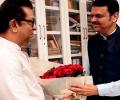
'The message is loud and clear: "If you're not falling in line, we will open a line of understanding with the MNS, and then the Shiv Sena will be in trouble".'

All eyes are now on the Sena factions, led by CM Shinde, backed by the BJP, and his predecessor Uddhav Thackeray, and their performance in the coastal belt in the November 20 polls.

Manmohan Singh represented the finest aspects of India, asserts Aakar Patel.

The fifth-term Lok Sabha member is the mascot of the party's Hindutva-wrapped agenda of development as the BJP makes a final push in its bid to capture power in the state

The Bharat Ratna for him comes nine years after the honour was bestowed on former prime minister Atal Bihari Vajpayee. The two leaders together spearheaded the journey of the Jana Sangh and then the BJP for over five decades.

Bhujbal stridently opposed Maratha quota activist Manoj Jarange's demand for Maratha quota from the Other Backward Classes (OBCs) share.

'No political party can antagonise Ambedkarite voters, particularly the neo-Buddhists.'

If Advani's ideological leadership galvanised the party's cadres and core support, Vajpayee soaring oratory, common touch and easy charm won over the masses.

Claiming that the BJP's government's works in the three holy cities are only follow-ups of her government's initiatives, Mayawati went on to promise, in what is being seen as a subtle shift towards soft Hindutva ahead of the Uttar Pradesh assembly polls, to complete all those work on time.

'The control of the Church over Christian people regarding politics has become weak...' 'People have started to think independently and it is not for sure that they will obey whatever the Church asks them to do.'

'There is a saying in Assamese about inflicting pain on an adversary: He cut my hands with a sword and rubbed salt into my wounds.' 'This has never been the BJP's culture but it started happening openly and frequently under Himanta Biswa Sarma.'
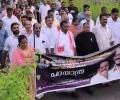
The specter of how the Munambam issue was exploited during the November by-elections is proof of the price Kerala is paying for its emergent politics. Controversies become the stuff of slow-burn and brinkmanship. The former promises mileage; the latter searches for an advantage, notes Shyam G Menon.

'In today's situation, it is not going to help anyone's case if they try to politically contest with the BJP on ideological issues.' 'Instead, it is best is to swim along the tide, present the more acceptable face of the cultural Hindu, but not be a political Hindu as the BJP or Mr Modi is.'

Bharat Rashtra Samithi's Goshamahal in-charge Nanda Kishore Vyas is pitted against Raja Singh from Goshamahal segment.

It is early to make out which way the wind is blowing, but there is no denying that challenges for the BJP, far outweigh the advantages in this region, notes Nilanjan Mukhopadhyay.

'If you look at the average age of all our candidates, you will notice that their average age is between 35 and 40. It is a kind of revolution that the MNS is bringing in Maharashtra.'

In focus are the assembly polls in 2026. From a BJP perspective, their attack on the ruling DMK, using the 'Hindutva' card, and Annamalai's targeting of both Dravidian majors on corruption has not worked, points out N Sathiya Moorthy.

'The 2024 general elections proved that UP is not Gujarat.'

'Besides Ayodhya, the BJP lost in nine other constituencies with a Ramayana imprint; it tasted success only in Thrissur.' 'In Rameswaram, K Navaskani of the Indian Union Muslim League won with a 44% voteshare in a 84% Hindu constituency.' 'In the 21 seats in the Ayodhya and Varanasi regions, both crucial to the Hindutva project, the BJP won just 7.' 'It won just 3 out of 12 seats around Modi's constituency,' points out Krishna Prasad.
'We should not underestimate the power of Hindutva.'

'What matters is policies, not personalities like Priyanka, Rahul or Modi.'

Lok Sabha constituencies that sprung a surprise in the 2024 polls.

'Someone who has lost a dear one to Covid; that person is not going to forget and will not vote for the BJP.'
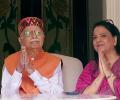
Most politicians and even non-politicians have been honoured because of what they were purported to be electorally worth for the ruling party of their time, argues N Sathiya Moorthy.

Shailaja Teacher, arguably the most famous Covid warrior in India, versus former student leader Shafi Parambil who defeated 'Metro Man' E Sreedharan in the last assembly election. Shyam G Menon reports from the Vadakara Lok Sabha constituency, which some feel is the most politically important contest in Kerala this election.

The best-case scenario is that the BJP will top out at around 50 seats in UP -- a drop of 12 from the 62 it had won in 2019. Taken in tandem with Maharashtra and Karnataka, this is what is likely to put paid to the BJP's ambitions of a third term for Modi, argues Prem Panicker.

A fierce competition among parties to offer freebies and guarantees, a scramble for tribal, OBC, women votes and a touch of Hindutva -- all have combined to make the Madhya Pradesh assembly polls a high-stakes battle with main rivals BJP and the Congress pulling out all the stops to gain power.

The gau rakshak stated that the famine-stricken people were suffering because of their past karma and nothing could be done for them. The reply apparently infuriated Vivekananda, who told the gau rakshak bluntly that he had no sympathy to spare for societies which would not lift a finger to help human beings but wasted piles of food on birds and beasts. A fascinating excerpt from Govind Krishnan V's book, Vivekananda The Philosopher of Freedom.
